
Data sciences
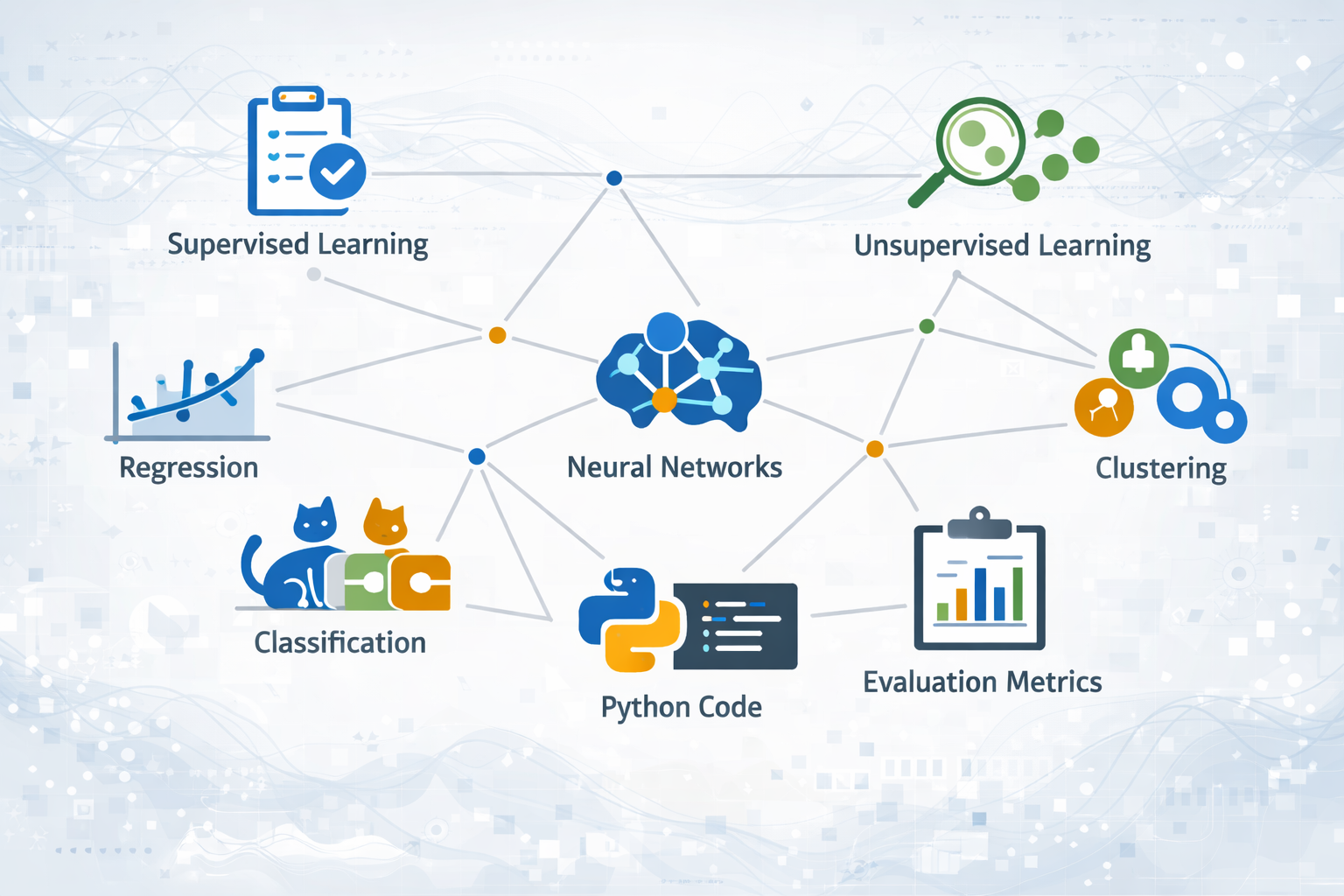
Welcome to the Machine Learning course. This course introduces the fundamental concepts and methods of machine learning, combining theoretical foundations with practical implementation using Python and libraries such as NumPy, scikit-learn, PyTorch, and TensorFlow. It is designed to provide a structured understanding of how models learn from data and how they are used in real-world applications.
Machine Learning is a core field of Data Science and Artificial Intelligence concerned with building systems that learn patterns from data to make predictions or decisions. This course provides an introduction to the main paradigms of machine learning and their practical use through hands-on exercises and projects.
Target Audience: This course is intended for 3rd-year engineering students in Computer Science, specializing in Data Science.
General Objectives
This course is centered on the main families of machine learning methods, their principles, and their evaluation within a unified framework. It covers:
- Supervised learning methods such as linear regression, logistic regression, and support vector machines.
- Unsupervised learning approaches including clustering, autoencoders, and anomaly detection.
- Model evaluation concepts such as performance metrics and the bias–variance tradeoff.
- Fundamentals of neural networks as an introduction to deep learning.
The focus is on understanding how these approaches are connected and how they are used to model and solve data-driven problems.
- Teacher: Ykhlef Hadjer
Ce cours explore la modélisation relationnelle avancée, les bases de données orientées objet et distribuées, ainsi que la programmation SQL avancée. Il aborde également la sécurité, l'optimisation des performances, les bases NoSQL et mobiles avec un focus sur la synchronisation et la gestion des conflits.
- Teacher: Lahiani Nesrine