
Plate-forme « Cours en ligne » de l'université Blida1
Résultats de la recherche: 1398
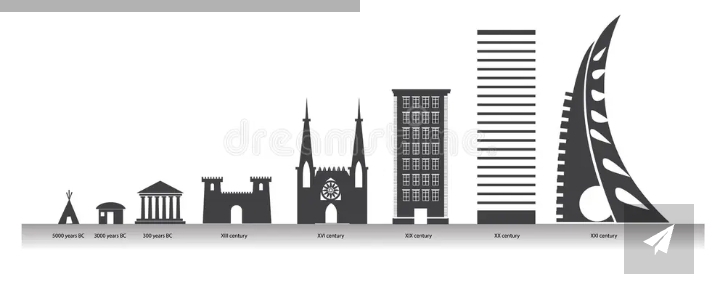
L'histoire de l'architecture ne se définit pas facilement, c'est l'histoire des édifices, de l'habiter, des techniques, des architectes. Par ailleurs, l'histoire de l'architecture est aussi celle de la conception architecturale, de la notion d'architecture, de ses définitions et de leurs effets sur la production du bâti.
- Enseignant: Amari Karima
Catégorie: 1ère Année L1
Sommaire :
I.Généralités et définitions :
1- Notion du Climat
· Climat en Algérie
· Appareilles de mesures
2- Notion du Temps
· Types de temps
3- Différence climat / temps
4- L’intérêt de l’étude de climat
II. Les indices climatiques :
Ø Utilisation des données climatiques
1- Differents indices d’aridite
a. Indice de pluie de LANG
b. Indice d’aridité de Martonne(1926)
c. Indice de sécheresse estivale d’Emberg1942
d. Daget et Al: 1975
2- Diagramme ombrothèrmique de Bagnouls et Gaussen
3- Quotient pluviothermique d'Emberger (1955)
4- Climagramme d’Emberger
5- Synthèse climatique
 <²
<²Catégorie: Ecologie et Environnement
Résumé : calcul des doses d'engrais
La dose d’engrais à appliquer à l’hectare dépend :
De la quantité d’éléments nutritifs nécessaires Et du type d’engrais disponible
Catégorie: S2
Résumé du TD de Protéomique
La protéomique est une discipline de la biologie qui étudie l'ensemble des protéines présentes dans un échantillon biologique à un moment donné. Ce domaine joue un rôle crucial dans la compréhension des processus biologiques, des maladies et du fonctionnement des organismes vivants à un niveau moléculaire.
Objectifs du TD :
1. Comprendre les principes fondamentaux de la protéomique.
2. Apprendre les techniques utilisées pour étudier les protéines.
3. Explorer les applications de la protéomique dans la recherche biomédicale.
Contenu du TD :
1. Introduction à la protéomique :Les étudiants seront introduits aux concepts de base de la protéomique, y compris la définition des protéines, leur structure et leur fonction dans les cellules.
2. **Techniques de séparation des protéines : Ce volet couvrira les différentes méthodes de séparation des protéines, telles que l'électrophorèse sur gel, la chromatographie et la spectrométrie de masse.
3. **Identification des protéines: Les étudiants apprendront les méthodes d'identification des protéines, notamment la spectrométrie de masse et les bases de données de séquences protéiques.
4. **Analyse bioinformatique : Ce volet abordera l'utilisation d'outils bioinformatiques pour analyser les données protéomiques, y compris l'alignement des séquences, la prédiction de la structure protéique et l'annotation fonctionnelle.
5. **Applications de la protéomique : Les étudiants découvriront les applications de la protéomique dans la recherche biomédicale, telles que l'étude des maladies, la pharmacologie et la médecine personnalisée.
- Enseignant: messaoudnacer imene
Catégorie: S1
Lorsque l’hormone atteint la cellule cible, celle-ci possède une structure particulière de
reconnaissance spécifique de cette hormone qu’on appelle « récepteur ».
La cellule cible doit répondre ultérieurement au message apporté par l’hormone libre, cette
réponse se fait toujours par l’intérieur de la cellule cible ; le message doit arriver à l’intérieur de la cellule cible.
L’hormone se lie obligatoirement à une structure protéique
spécifique appelée « récepteur ».
Ce récepteur possède deux fonctions :
- reconnaissance et liaison de l’hormone avec une grande affinité ;
- transformation de l’interaction hormone-récepteur en un signal qui déclenche l’organisation de la réponse cellulaire.
Classification des récepteurs
Les récepteurs sont classés en deux groupes selon la nature physico-chimique de l’hormone :
- récepteurs membranaires ou de surface : ces récepteurs sont localisés à l’intérieur des membranes. Ils présentent un domaine extracellulaire, un domaine transmembranaire et un domaine intracellulaire. Les hormones qui se lient à ces récepteurs sont des hormones hydrophiles qui sont incapables de traverser les membranes lipidiques, donc ce sont les hormones protéiques ; l’information apportée par l’hormone doit atteindre l’intérieur de la cellule, la cellule utilise des relais pour transmettre cette information, c’est ce qu’on appelle le mécanisme de transduction: c’est le transfert de l’information de l’extérieur de la cellule vers l’intérieur de la cellule ;
- récepteurs intracellulaires : ces récepteurs interagissent avec les hormones lipophiles qui sont capables de traverser les membranes.
BIREM ZahiaCatégorie: L3
TD Traitement du Signal pour les Etudiants S4 option Électrotechnique
Enseignate: Ait Messaoud Lysa
Catégorie: Semestre 4
objectif:
Exposé les principales races et robes chez le chien.
- Enseignant: BOUKERT Razika
Catégorie: 2ème Année
le dépistage de la scoliose en milieu scolaire est un temps clé dans la formation du médecin généraliste surtout s'il va exercer dans la médecine scolaire
pour se faire il est essentiel de connaitre la définition de la scoliose qui est une déformation tridimensionnelle du rachis, non complètement réductible. Elle se caractérise cliniquement par la gibbosité qui traduit la rotation vertébrale.
Cette
définition élimine l’attitude scoliotique qui est une déviation latérale du
rachis, complètement réductible en position couchée sans gibbosité et sans
rotation vertébrale. La
scoliose idiopathique est une maladie déformante de la Colonne Vertébrale qui évolue jusqu’à
maturité osseuse, sans cause connue.
Catégorie: Département de Médecine

Unité d’enseignement : Législation du travail
Année universitaire : 2023/2024/S2
- Enseignant: TOUMI Mohamed
Catégorie: 2éme Année

The "Technical English" is a course addressed to Hydraulic students, in oder to provid them with the essential language and communication skills required to delve in the field of hydraulics and fluid mechanics.
This specialized course focuses on improving students' English language proficiency in the context of hydraulic engineering, ensuring they can effectively communicate, understand, and document technical information.
- Enseignant: Ft découverte
- Enseignant: KARA OMAR Abdellah
Catégorie: L2

This technical English course focuses on the assimilation of the elements of speech, which are essential components of sentence formation. Their mastery will allow the learner to be able to use these components to communicateboth in writing and orally.
The main objectives are:
-Be able to communicate in writing and orally in a professional setting, regardless of the learner's entry level
-Guide learners towards a good mastery of different characteristics of the language
- Deepening of grammar, learning of translation techniques, enrichment of written and oral expression, discovery of the culture of Anglo-Saxon countries.
-allow the student to have access to technical documentation, which will allow him to stay informed of the latest technological advances, as generally published in English.
- Enseignant: OMARI Souhila
Catégorie: Département ST Ingénieur
This technical English course focuses on the assimilation of the elements of speech, which are essential components of sentence formation. Their mastery will allow the learner to be able to use these components to communicate both in writing and orally.
- Enseignant: Ft S1 transversale
- Enseignant: Sakri Asma
Catégorie: 1ére Année Ingénieur
This lesson is dedicated to Mechanical Engineering students, Materials and Surface Engineering.
- Enseignant: Ft S1 transversale
- Enseignant: hadji mohamed
Catégorie: M1

What are the aims of this course?
This course will help students in the field of technology (Renewable energies, electronics..etc) increasing their knowledge of technical English and develop their vocabulary. It covers the core language and skills that students need to understand successfully:
- how to write a well-structured technical report/email/introduction/abstract/conclusion/acknowledgment...etc
- citation and references
- how to read numbers, mathematical symbols and formulas,
- how to deal with clusters of mathematical equations,
- how to employ prepositions pf position and direction
- most of the existing technologies used to produce and store clean energy.
- Measurements and units
- Storage Systems, power, Electricity....etc
- equipment/devices/component/tools used in the filed of technology
- others- Enseignant: BOUKENOUI Rachid
Catégorie: SEMESTRE2
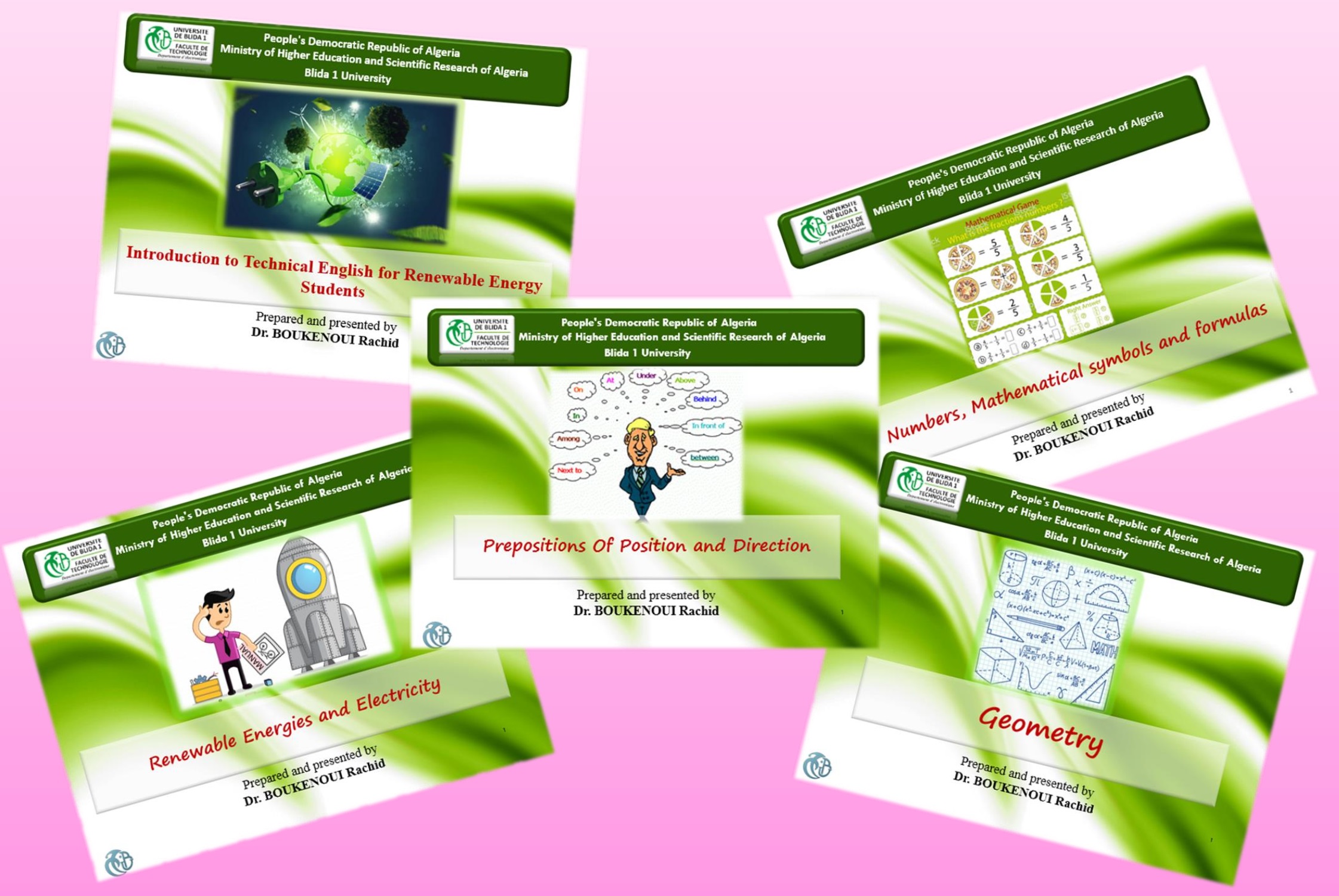
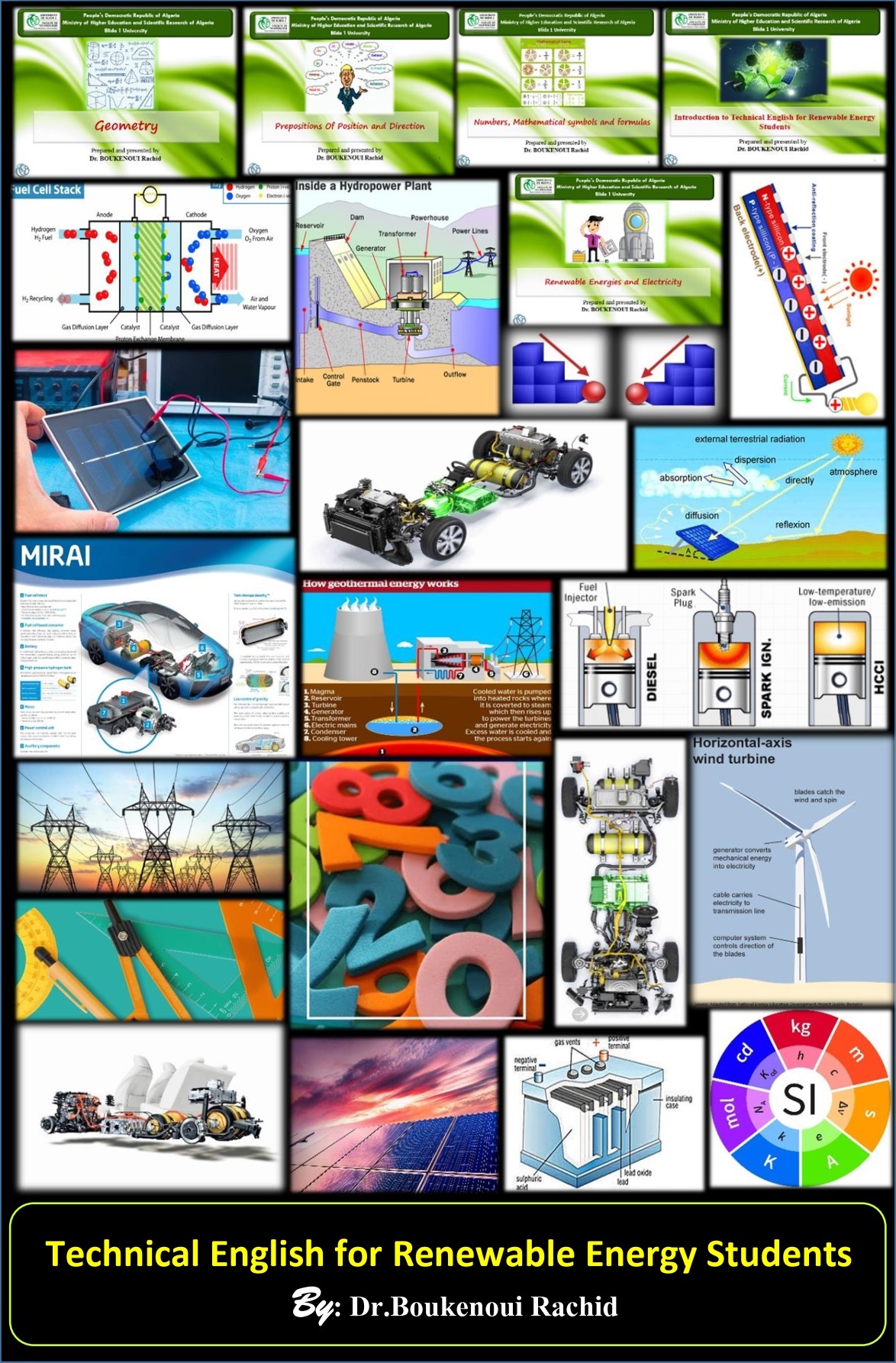
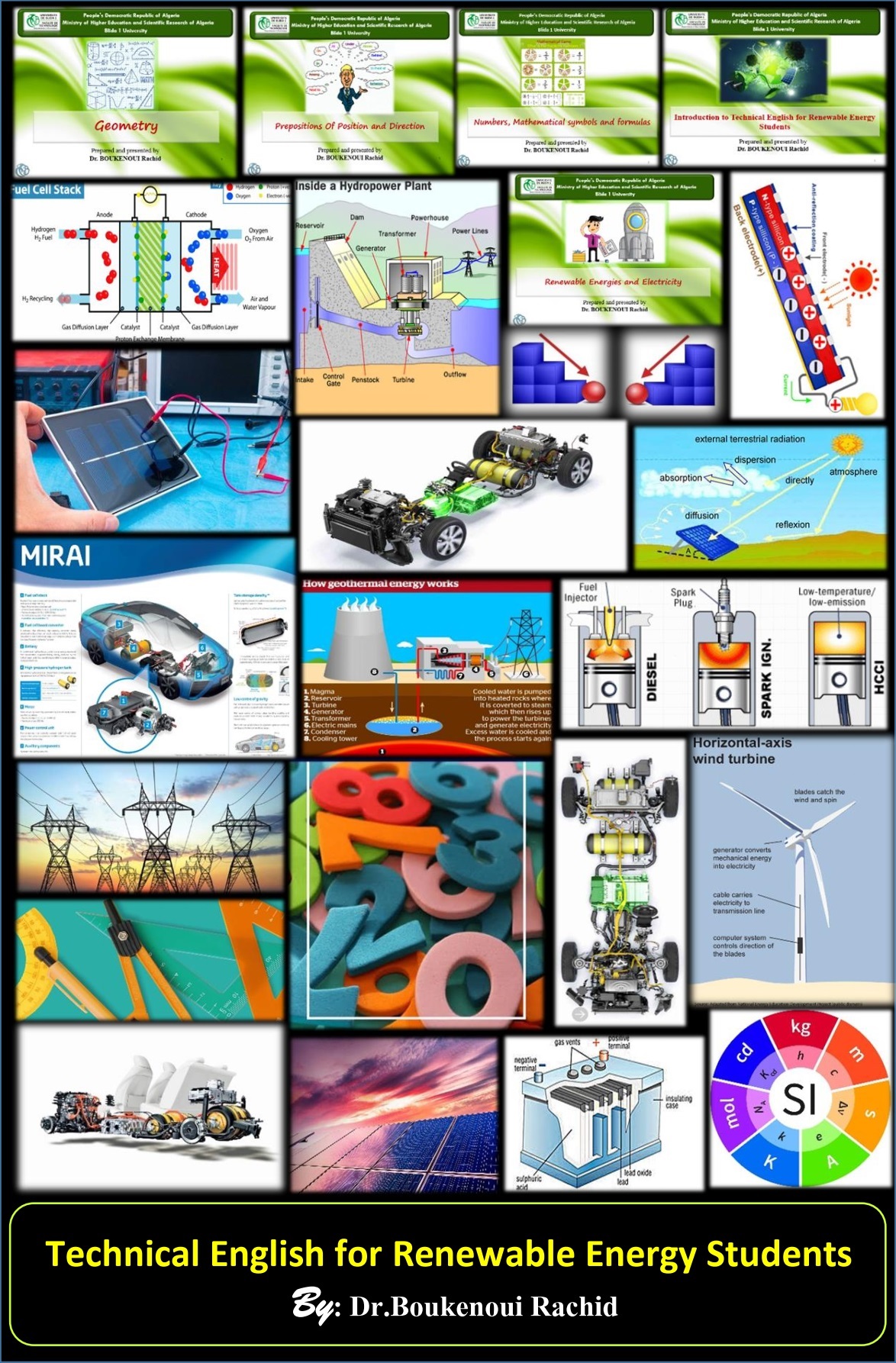
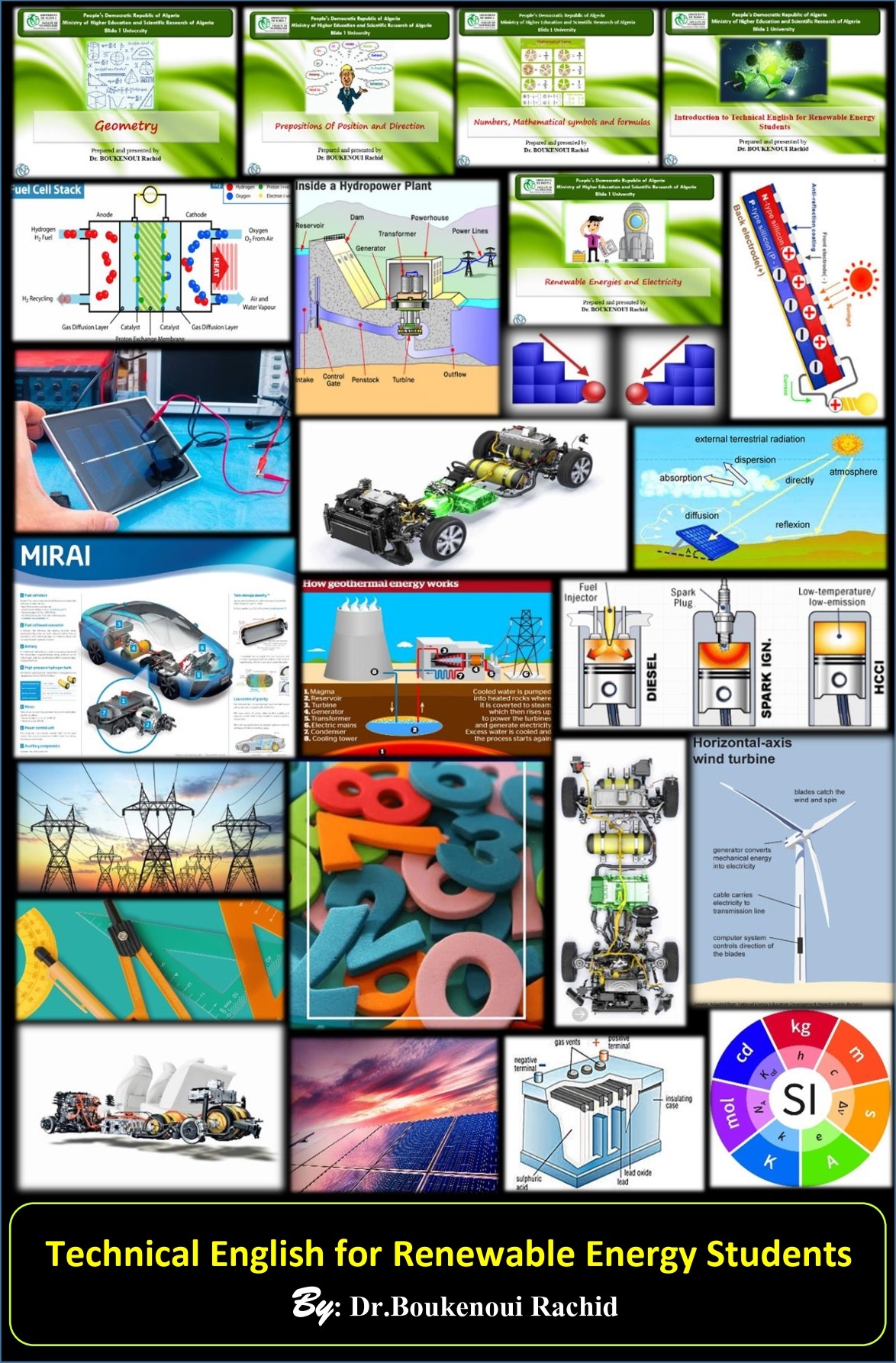
What is Technical English for Renewable Energy Students (TERES)?
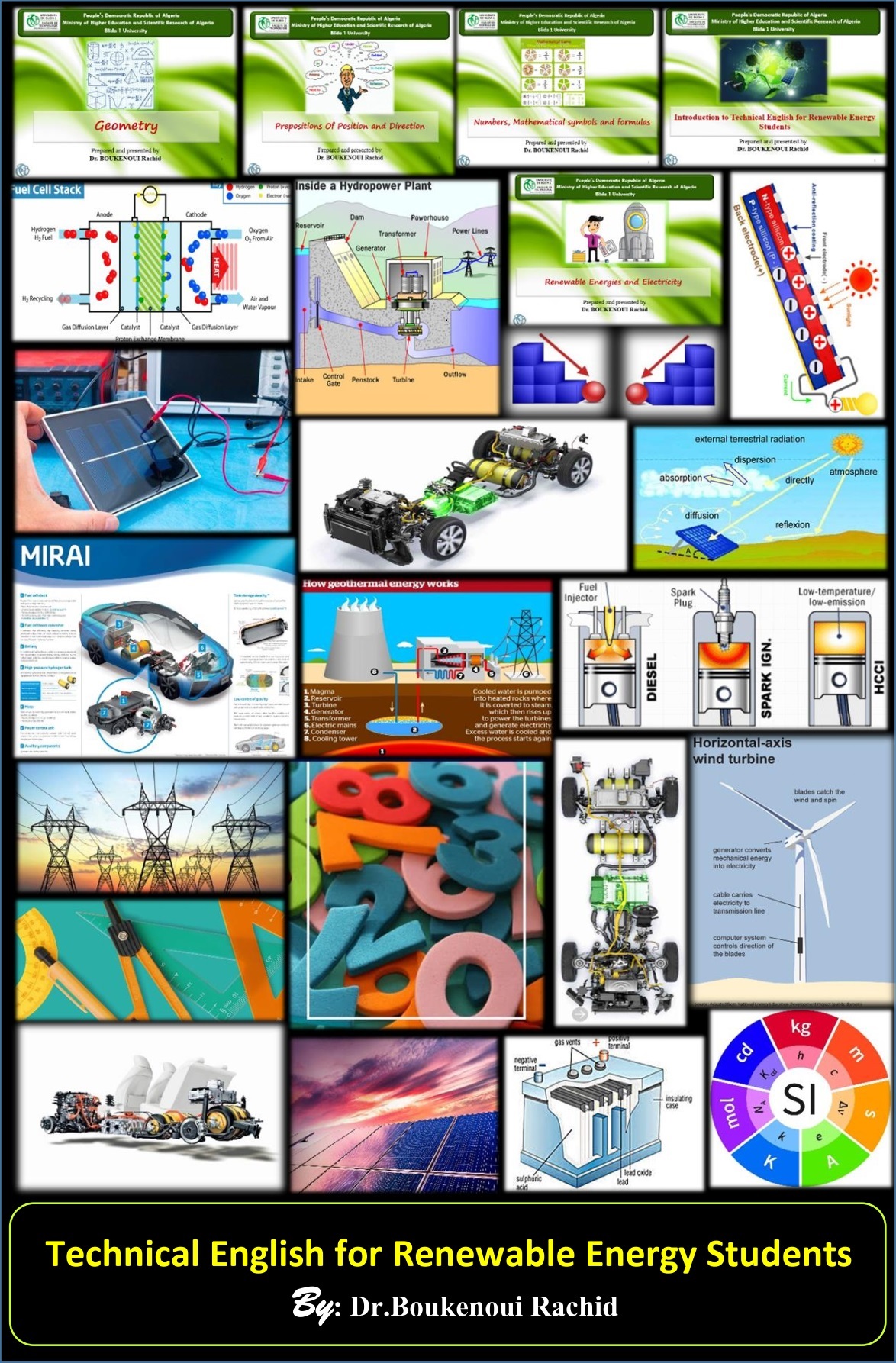
This course will help students in the field of Renewable energies (Master 1 and 2) increasing their knowledge of technical English and develop their vocabulary. It covers the core language and skills that students need to understand successfully all the existing technologies used to produce and store clean energy.
What is in TERES ?
TERES has two levels. Level 1 is for students with a basic knowledge of general English who require an elementary course in English for specific purposes. Level 2 is for students who have completed Level 1, or have an elementary knowledge of general English, and now require a detailed course about the existing sources of energy.
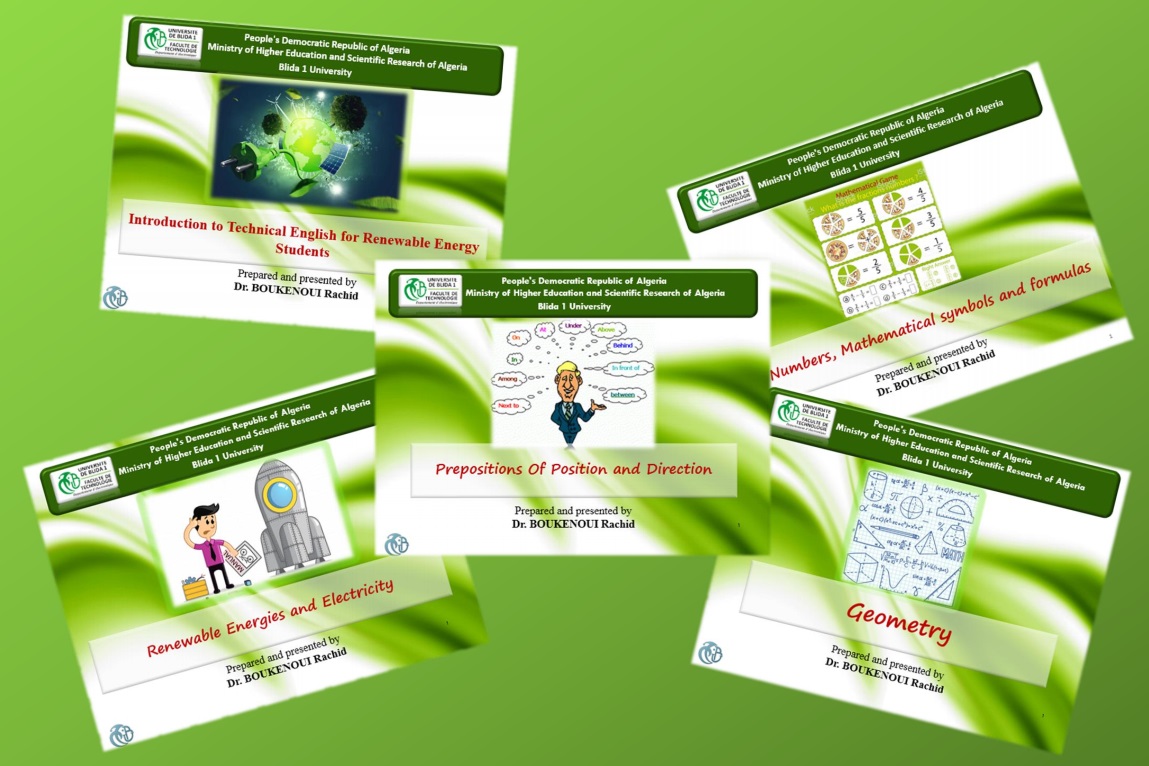
Level 1 is composed of four topic areas, which are:
1) Introduction to Technical English for Renewable Energy Students
2) Numbers, Mathematical symbols and formulas
3) Geometry
4) Prepositions Of Position and Direction
Level 2 (Renewable Energies and electricity) is composed of the following topics:
1) Conventional Energy
2) Renewable Energy
3) Hydrogen energy
4) Solar Energy and Photovoltaic
5) Thermal Energy
6) Biomass energy
7) Wind energy
8) Geothermal energy
9) Ocean Energy
10) Hydroelectric Energy
11) Storage Systems
12) Power and Electricity
13) Tools
14) Measurements and Units
Catégorie: S2

What is Technical English for Renewable Energy Students (TERES)?
This course will help students in the field of Renewable energies (Master 1 and 2) increasing their knowledge of technical English and develop their vocabulary. It covers the core language and skills that students need to understand successfully all the existing technologies used to produce and store clean energy.
What is in TERES ?
TERES has two levels. Level 1 is for students with a basic knowledge of general English who require an elementary course in English for specific purposes. Level 2 is for students who have completed Level 1, or have an elementary knowledge of general English, and now require a detailed course about the existing sources of energy.
Level 1 is composed of four topic areas, which are:
1) Introduction to Technical English for Renewable Energy Students
2) Numbers, Mathematical symbols and formulas
3) Geometry
4) Prepositions Of Position and Direction
Level 2 (Renewable Energies and electricity) is composed of the following topics:
1) Conventional Energy
2) Renewable Energy
3) Hydrogen energy
4) Solar Energy and Photovoltaic
5) Thermal Energy
6) Biomass energy
7) Wind energy
8) Geothermal energy
9) Ocean Energy
10) Hydroelectric Energy
11) Storage Systems
12) Power and Electricity
13) Tools
14) Measurements and Units
Catégorie: S2
What is Technical English for Renewable Energy Students (TERES)?
This course will help students in the field of Renewable energies (Master 1 and 2) increasing their knowledge of technical English and develop their vocabulary. It covers the core language and skills that students need to understand successfully all the existing technologies used to produce and store clean energy.
What is in TERES ?
TERES has two levels. Level 1 is for students with a basic knowledge of general English who require an elementary course in English for specific purposes. Level 2 is for students who have completed Level 1, or have an elementary knowledge of general English, and now require a detailed course about the existing sources of energy.
Level 1 is composed of four topic areas, which are:
1) Introduction to Technical English for Renewable Energy Students
2) Numbers, Mathematical symbols and formulas
3) Geometry
4) Prepositions Of Position and Direction
Level 2 (Renewable Energies and electricity) is composed of the following topics:
1) Conventional Energy
2) Renewable Energy
3) Hydrogen energy
4) Solar Energy and Photovoltaic
5) Thermal Energy
6) Biomass energy
7) Wind energy
8) Geothermal energy
9) Ocean Energy
10) Hydroelectric Energy
11) Storage Systems
12) Power and Electricity
13) Tools
14) Measurements and Units
Catégorie: S3
What is Technical English for Renewable Energy Students (TERES)?
This course will help students in the field of Renewable energies (Master 1 and 2) increasing their knowledge of technical English and develop their vocabulary. It covers the core language and skills that students need to understand successfully all the existing technologies used to produce and store clean energy.
What is in TERES ?
TERES has two levels. Level 1 is for students with a basic knowledge of general English who require an elementary course in English for specific purposes. Level 2 is for students who have completed Level 1, or have an elementary knowledge of general English, and now require a detailed course about the existing sources of energy.
Level 1 is composed of four topic areas, which are:
1) Introduction to Technical English for Renewable Energy Students
2) Numbers, Mathematical symbols and formulas
3) Geometry
4) Prepositions Of Position and Direction
Level 2 (Renewable Energies and electricity) is composed of the following topics:
1) Conventional Energy
2) Renewable Energy
3) Hydrogen energy
4) Solar Energy and Photovoltaic
5) Thermal Energy
6) Biomass energy
7) Wind energy
8) Geothermal energy
9) Ocean Energy
10) Hydroelectric Energy
11) Storage Systems
12) Power and Electricity
13) Tools
14) Measurements and Units

Catégorie: S2
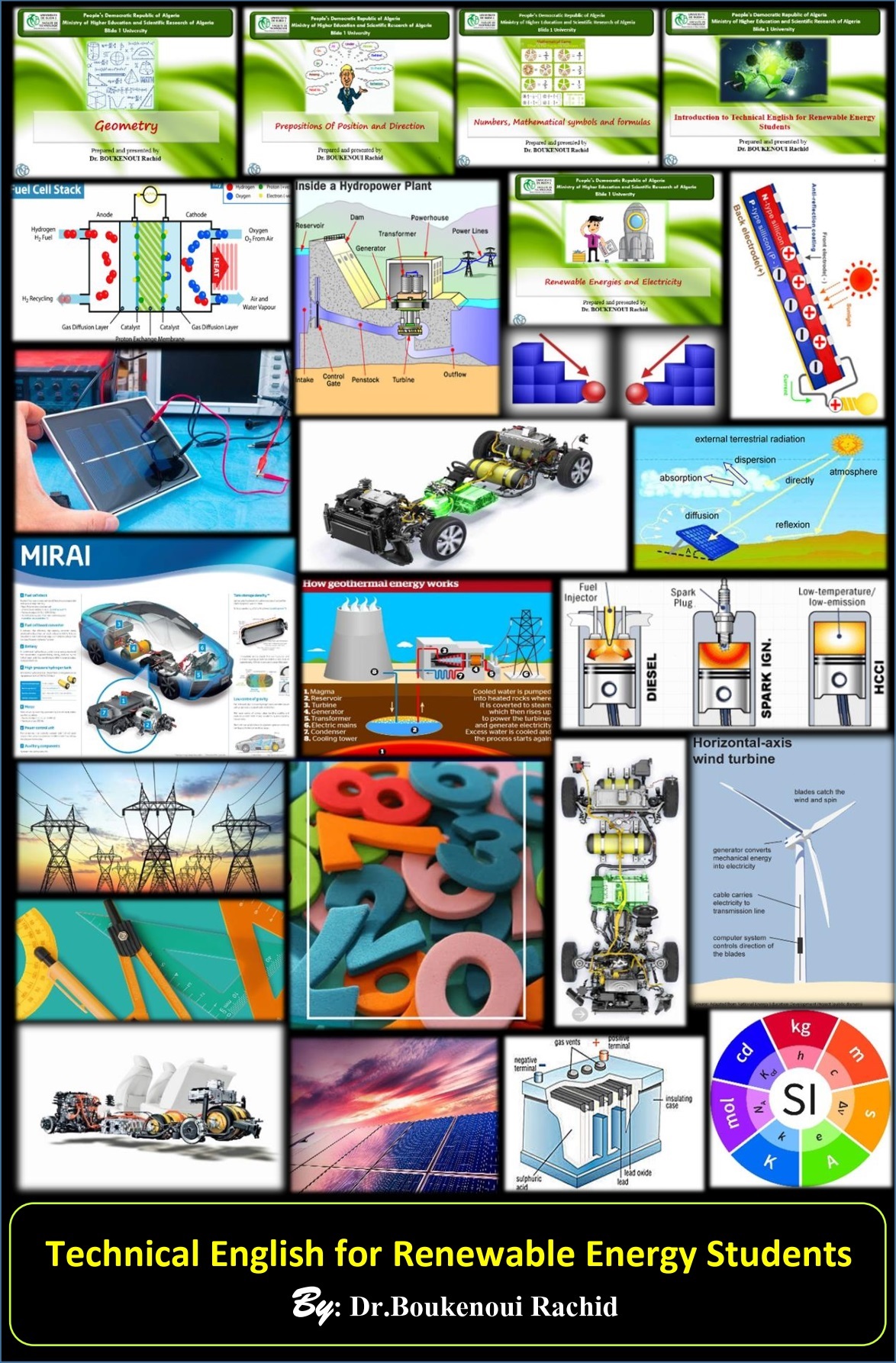
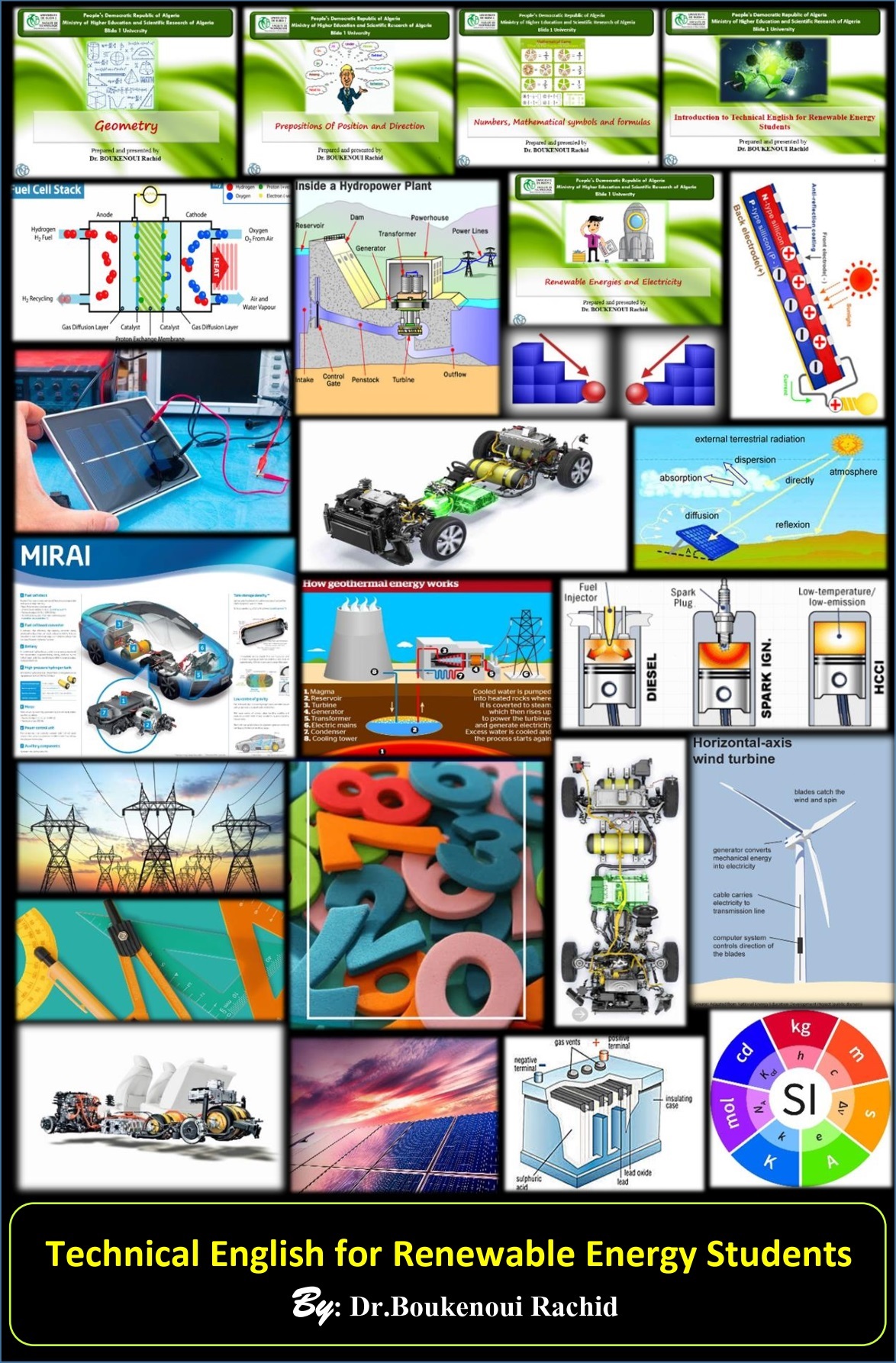
What is Technical English for Renewable Energy Students (TERES)?
This course will help students in the field of Renewable energies (Master 1 and 2) increasing their knowledge of technical English and develop their vocabulary. It covers the core language and skills that students need to understand successfully all the existing technologies used to produce and store clean energy.
What is in TERES ?
TERES has two levels. Level 1 is for students with a basic knowledge of general English who require an elementary course in English for specific purposes. Level 2 is for students who have completed Level 1, or have an elementary knowledge of general English, and now require a detailed course about the existing sources of energy.
Level 1 is composed of four topic areas, which are:
1) Introduction to Technical English for Renewable Energy Students
2) Numbers, Mathematical symbols and formulas
3) Geometry
4) Prepositions Of Position and Direction
Level 2 (Renewable Energies and electricity) is composed of the following topics:
1) Conventional Energy
2) Renewable Energy
3) Hydrogen energy
4) Solar Energy and Photovoltaic
5) Thermal Energy
6) Biomass energy
7) Wind energy
8) Geothermal energy
9) Ocean Energy
10) Hydroelectric Energy
11) Storage Systems
12) Power and Electricity
13) Tools
14) Measurements and Units
Catégorie: S3
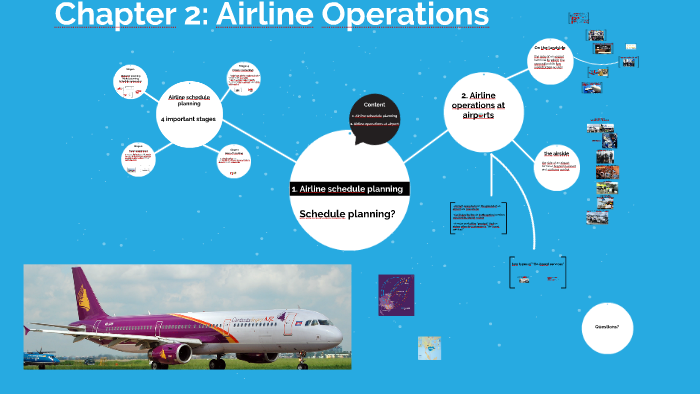
Technical English is designed to help students of Institute for Aeronautics and Aerospace Studies to improve their skills in this special field of Aeronautical Engineering. This lecture deals with different subjects related to the Aeronautics and Aviation areas. The main objectives for this is to develop their intellectual, personal and professional abilities to understand the original textbooks in aeronautics. The course is running in the first and second semester of every year beginning in September provided for underground level students (L2). Overall, Technical English gives students the language, information, and skills needed for their university program of study. It presents them with English from a variety of technological fields and situations, and develops their communication skills. The main objectives of this course are:
- To Provide Technical English instruction to enhance students’ reading and writing in order to provide practice & interest in the language of Aeronautics and Aerospace Fields.
- To prepare students to sit for assessments and evaluations such as tests and quizzes in order to test and revise proper acquisition of the English language.
- To allow students to gain key strategies and expressions for communicating with professionals and non-specialists.
- Enseignant: Aomar ABDESSELAM
Catégorie: Département navigation aérienne